Neuroaffirming Advocacy Resources
Access practical tools, educational content, trusted websites, and advocacy resources designed to help families, educators, related service professionals, and advocates better understand special education and support neurodivergent learners.
Resources address IEPs, 504 Plans, evaluations, accommodations, FAPE, communication, regulation, behavior, mental health, ableism, intersectionality, disability rights, and neuroaffirming practice.
Start with a free resource, explore the resource shop, or browse trusted advocacy
Neuroaffirming Advocacy: A Parent and Educator Guide to Special Education, 2nd Edition
Looking for a more in-depth guide to neuroaffirming special education advocacy? Explore Dr. Destiny Huff’s book, Neuroaffirming Advocacy: A Parent and Educator Guide to Special Education, created to help families, educators, and advocates better understand IEPs, disability, access, communication, regulation, and inclusive support.
Free Advocacy Resources
Download practical tools designed to help you prepare for meetings, understand special education language, organize concerns, and identify supports that may improve a learner’s educational access.
Topics may include:
-
Hidden Curriculum of Ableism
-
Let's talk about different types of stims
-
IEP Language
-
Four Functions of Behavior
These resources are intended to make complex information more understandable and help families participate more meaningfully in the special education process.
Resource Shop
Explore in-depth guides, templates, advocacy tools, and educational resources created for parents, educators, advocates, therapists, and related service professionals.
Resources are designed to support:
-
Inclusive Practices
-
Neuroaffirming De-escalation Tips
-
Common misdiagnoses for Neurodivergent Black Youth
-
ADHD Criteria versus Neuroaffirming Language
-
Deficit and Strength Based Language
-
Accommodations versus Modifications
-
Procedural versus Substantive Violations
-
FAPE: What is it?
-
Polyvagal Theory and Neuroaffirming Practices
-
Trauma: Advocating for Your Learner's Mental Health
The Affirming Village Podcast
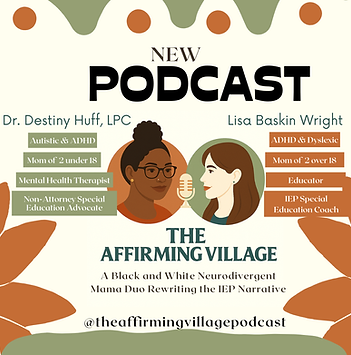
The Affirming Village Podcast features conversations about neurodivergence, parenting, education, mental health, disability, race, relationships, advocacy, and the work of creating more affirming communities.
Hosted by Dr. Destiny Huff and Lisa Baskin Wright, the podcast centers lived experience and explores what meaningful support can look like across home, school, and community settings.
Apple Podcast
.png)
Spotify

YouTube
.png)
Current Advocacy Actions
This section includes time-sensitive opportunities to contact elected officials, submit public comments, access community-created advocacy materials, or take action on issues affecting disabled people and families. Information, deadlines, and policy proposals may change. Please confirm current details through the original source before participating.
Concerns About Autism Data Collection and Privacy
Disabled people, families, advocates, and community organizations have raised concerns about transparency, consent, privacy, data sharing, and the potential misuse of Autistic people’s medical and personal information.
📢 @blackspectrumscholar has created a powerful template letter you can send to your representatives to speak out.
There are three tabs-
1. Actually, Autistic
2. Caregiver
3. Allies.
Last updated: [Insert date]
Additional Advocacy Actions
Added: June 2026
Take Action to Protect Life-Saving Healthcare for Immigrant Children
Organizer: Tennessee Immigrant & Refugee Rights Coalition; Tennessee Justice Center
-
Tennessee officials are moving to share information about immigrant children enrolled in Children’s Special Services with immigration enforcement agencies. The program supports children with serious disabilities and medical conditions, including cerebral palsy, cystic fibrosis, diabetes, sickle cell anemia, seizure disorders, and congenital heart conditions. Advocates warn that linking healthcare access to immigration enforcement could cause families to avoid life-saving services, placing already vulnerable children at greater risk.
Added: May 2026
Protect Non-Verbal Children—Mandate Audio & Video in All SPED Classrooms & ABA Centers
Organizer: Amanda Lindskog
-
This petition calls for federal and state legislation requiring audio and video monitoring, with appropriate privacy protections, in public school special education classrooms and private ABA facilities. Supporters argue that increased oversight and transparency are needed to protect disabled children—particularly those who may not be able to reliably report mistreatment—and are also seeking stronger background-check standards and accountability requirements for staff and providers.
Take Action
Use these tools to identify elected officials, contact decision-makers, and learn more about legislation, public policy, funding, and government decisions affecting education and disability communities.
5 Calls
A tool that helps users contact elected officials about current policy issues and legislative priorities.
Find and Contact Elected Officials
Locate federal, state, and local elected officials and find their official contact information.
Find Your Representative
Enter your address to identify your member of the United States House of Representatives.
Track Legislation and Public Policy
Use official government resources to review proposed legislation, committee activity, voting records, and policy updates.
External advocacy tools are provided for informational purposes. Review each website’s privacy practices before submitting personal information.
Recommended Reading
-
Autism study is my life’s work. The spectrum has lost all meaning
-
Unidentified Dyslexia Takes Heavy Toll
-
School staff failed 11-year-old during seizure that led to his death, parents claim
-
RFK Jr.'s Autism Study to Amass Medical Records of Many Americans
-
National Education Association
-
HHS taps anti-vaccine activists to look at debunked links between autism and vaccines, sources say
Trusted Special Education and Disability Rights Websites
Federal law that protects the privacy of students education records.
OCR’s mission is to ensure equal access to education and to promote educational excellence through vigorous enforcement of civil rights in our nation’s schools.
Welcome to the U.S. Department of Education’s Individuals with Disabilities Education Act (IDEA) website, which brings together IDEA information and resources from the Department and our grantees.
The Office of Special Education and Rehabilitative Services (OSERS) understands the many challenges still facing individuals with disabilities and their families. Therefore, OSERS is committed to improving results and outcomes for people with disabilities of all ages. OSERS supports programs that serve millions of children, youth and adults with disabilities
The mission of the Office of Special Education Programs (OSEP) is to lead the nation's efforts to improve outcomes for children with disabilities, birth through 21, and their families, ensuring access to fair, equitable, and high-quality education and services. Our vision is for a world in which individuals with disabilities have unlimited opportunities to learn and to lead purposeful and fulfilling lives.
An official website of the Department of Defense. DoDEA is a Department of Defense Field Activity operating under the direction, authority, and control of the Undersecretary of Defense for Personnel and Readiness.
Exceptional Families of the Military’s mission is to connect military families with Disabilities, Special Healthcare Needs, or additional educational needs from all branches of the service in order to navigate within the Exceptional Family Member Programs and identify areas of improvement that affect the families we represent.
MCEC supports all military-connected children by educating, advocating, and collaborating to resolve education challenges associated with the military lifestyle.
Founded in 2008, the Military Interstate Children’s Compact Commission (MIC3) is the governing body of the Interstate Compact on Educational Opportunity for Military Children or ICEOMC. Commission members include the 50 states, District of Columbia, and five ex-officio representatives – which include the US Department of Defense. The collaborative’s mission, to ease the educational transitions of school-aged, military-connected students attending public schools and Department of Defense schools worldwide, also promulgates and enforces the compact rules.
Our mission is to Protect the Rights Of Military children in Special Education and disability communities to ensure they receive equal access to an education. We develop data-informed solutions that equip parents, inform leaders and enable military students to thrive. We promote the principles of diversity, equity and inclusion by advocating for the futures of our military children with unique and diverse backgrounds and needs.
Want a resource added, click the link below and let me know!
Know of a helpful special education, disability, advocacy, or neuroaffirming resource that may benefit families or professionals?
You may submit it for consideration.
Submitting a resource does not guarantee that it will be added. Resources are reviewed for relevance, accessibility, accuracy, alignment, and potential value to the community.
Resouce Disclaimer
Resources, articles, tools, and external links are provided for educational and informational purposes only.
Their inclusion does not constitute legal advice, legal representation, or endorsement of every position, statement, product, service, or practice offered by an outside organization.
External information may change over time. Review the original source, confirm that information is current, and consult a licensed attorney when legal advice is needed.
Continue Learning
General resources can help you prepare, but they cannot address every learner, document, school system, or family situation.
Dr. Destiny Huff, LPC provides virtual, non-attorney special education advocacy to help families understand records, identify barriers, prepare for meetings, communicate concerns, and advocate for support that centers the learner’s access, identity, autonomy, communication, regulation, and mental health.